Tuesday, October 8, 2013

Pyotr Ilyich Tchaikovsky: The Most Popular Romantic Composer


Historical Period: Romantic
Nationality: Russian
Born: May 7, 1840 A.D. in Kamsko-Votkinsk, Vyatka
Died:  Nov. 6, 1893 A.D. in St. Petersburg
Contemporaries: Johannes Brahms, Camille Saint-Saens, Antonin Dvorak, Claude Debusey, Gustav Mahler, Edvard, Grieg, Frederic Chopin, Franz Liszt, Gabriel Faure, Robert Schumann, Richard Wagner, Nikolai Rimsky-Korsakov, Modest Mussrogsky, Cesar Cui, Alexander Borodin, Mily Balakirev
Specialist Genres: ballet music and symphonies
Major Works: The Nutcracker, Swan Lake, Sleeping Beauty, Violin Concerto, Piano Concertos, 6 symphonies, 1812 Overture.


     Have you ever heard of The Nutcracker? Or Sleeping Beauty? Or even Swan Lake? Most people have, but they may not know much about the man behind the music. The man is Pyotr Ilyich Tchaikovsky and he was born in Votkinsk, a small town in Russia’s Ural Mountains. Tchaikovsky lived during stirring times: the United States of America was in the Great Depression, Samuel Morse invented “Morse Code”, David Livingstone went as a missionary to Africa, lower and upper China united, Crawford Long uses first anesthetic (ether), Edgar Allen Poe came out with The Raven and Other Poems, and Charles H. Spurgeon impacted England and America with his great sermons from the Bible. 


It was in these tremendous times that Pyotr Ilyich Tchaikovsky played the piano and wrote lots of cool classical music with a Russian twist. Alongside ballet music, Tchaikovsky wrote symphonies, the 1812 Overture, a violin concerto and piano concertos. Tchaikovsky had what many composers living in his time did not: “a sweet, inexhaustible, supersensuous fund of melody.”[1]


His Life & Music

Pyotr Ilyich Tchaikovsky was born on May 7, 1840.  From a young age Tchaikovsky had an interest in music, but his parents wanted him to study law, just like G.F. Handel. Tchaikovsky was an obedient son and went to law school, but he also kept pursuing music. Eventually,  Tchaikovsky went to the St. Petersburg Conservatory to study music composition and the piano, which led him to be considered one of the most popular classical music composers of all time.


After the St. Petersburg Conservatory, Tchaikovsky was given the great gift of marriage, but he did not treasure marriage. Tchaikovsky divorced his wife a few weeks after they were married, choosing to run away from her and focused on his music. Music was more important to Tchaikovsky, too bad he did not choose to love both music and his wife. He did write a lot of beautiful music, symphonies and piano concertos and a violin concerto and ballet music and tone poems and more. In 1891, Tchaikovsky even came to America to conduct his music for people. And in 1884, Emperor Alexander III and even got a pension (money for retirement). People really like his ballet music, his symphonies and even the concertos for its beauty, deep emotion, lyricism in the Russian style.  As two historians put it, “The music which this unhappy man created was gorgeously colored, sometimes delicate and fairy-like, sometimes almost hysterical in its tragic passion.”[2]


[1]Harold C. Schonberg, The Lives of the Great Composers, revised edition (New York: Norton Company, 1981), p. 377.
[2]Katherine B. Shippen and Anca Seidlova, The Heritage of Music (New York: Viking Press, 1963), p. 204.

Copyright © 2013 Mircea & Daniyela Ionescu. All rights reserved.

Saturday, September 14, 2013

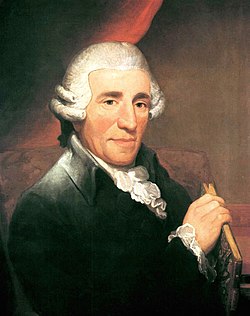
Franz Joseph Haydn: The Forgotten Master

Historical Period: Classical
Nationality: Austrian
Born: March 31, 1732 A.D. in Rohrau, Austria.
Died:  May 31, 1809 A.D. in Vienna, Austria
Contemporaries: Johann Sebastian Bach, Ludwig van Beethoven, George Friedrich Handel, Wolfgang Amadeus Mozart.
Specialist Genres: symphony, string quartet, concerto.
Major Works: chamber music and songs, cantatas, violin and keyboard concertos, harpsichord sonatas, 12 masses, oratorio, 15 surviving operas, keyboard sonatas, Stabat Mater, string quartets, and 104 symphonies.

What's the Big Deal with Haydn?

If someone would ask you what you know about Franz Joseph Haydn, what would you tell them? Here are a few things that you could tell them. Franz Joseph Haydn is the forgotten master of classical music. Franz Joseph Haydn taught Ludwig van Beethoven and was close friends with Wolfgang Amadeus Mozart, and pretty much invented the musical form of the concerto, string quartet, sonata and symphony in the Classical period.[1] But not many people know about Haydn’s achievements, that is why he is the forgotten master of classical music.

The Early Years 

          
In the time of the Enlightenment, America revolted against Great Britain becoming its own country (1776);  Adam Smith had written about his ideas of capitalism; Jean-Jacques Rousseau had written Emile on the innate goodness of man and how people just need a good education; it was not well-received); John Wesley and George Whitefield were preaching to multitudes in America about the need to be born again. This brought the First Great Awakening in America where many people turned to God. It was during this time that Franz Joseph Haydn came on the scene in Europe bringing with him many new musical ideas.

         Franz was one of 12 children in the Haydn family, at age 8 he was recruited to the sing in the choir at St. Stephen's Cathedral in Vienna because of his beautiful singing voice just like Palestrina and Monteverdi.  It was at St. Stephen's that Franz went on to learn to play violin and keyboard. Some scholars think that Haydn even learned the organ during these years, so we can see that Haydn has something in common  with Scarlatti; they both played the harpsichord and organ. After a few years, Haydn’s voice changed (just like any boy), so he could not sing in the choir anymore. He then left the choir and started working as a music teacher and playing violin, while studying counterpoint and harmony in his spare time. This was a difficult time in Haydn's life because he did not make much money, and during this time in history parents did not help out their children very much after they finished school.


Haydn's Boss: The Esterházs

        In 1761 Joseph Haydn was named Kapellmeister, or "court musician," at the palace of the influential Esterházy family after Prince Paul Anton heard one of his symphonies. It was his job to train the choir and orchestra, and take care of the instruments and music at Eisenstadt where the Esterházys lived. Haydn worked for the Esterházy family for 30 years writing symphonies, concertos, string quartets, trios, and even music for the viola d'amore; the instrument that his boss played. After Haydn finished working for the Esterházy family he was able to go throughout Europe to write and perform more music.


[1] Max Wade-Matthews and Wendy Thompson, Joseph Haydn in The Encyclopedia of Music: Instruments of the Orchestra and the Great Composers (New York: Hermes House, 2002), p. 323.

Copyright © 2013 Mircea & Daniyela Ionescu. All rights reserved.

Friday, September 13, 2013

Suzuki Cello Book 1, No. 2: French Folk Song - Tips


Focus Points:

  • Get into a good playing position every time, making sure the fingers on the bow are curved and the left thumb is on the neck under the 2nd finger.
  • This piece starts with four fingers on the A sting.
  • There are a lot of 3 note groupings, watch for that as you play the piece.
  • Make sure to play with a smooth bow connecting the notes.
  • Practice at a speed where you do not feel rushed and after you get comfortable with the piece you can speed it up.
Copyright © 2013 Mircea & Daniyela Ionescu. All rights reserved.
Thursday, September 12, 2013

Practicing (with My Child): When?

When is the best time to practice my music (with my child)? 

The short answer: Make sure that it is a time when the musician ( or in some instances parent and child ) are awake and ready to concentrate.

Many people are very concerned with how long to practice but they do not give much thought to the time of their practice. Some musicians, and parents, think you can just shove the practice somewhere in the day and get it done. But this only breeds frustration, slow progress, less enjoyment and may even pick up some bad habits when there is tiredness and distractions for most people.

For young children, the best way to do it is to have the same practice time throughout the week. As William and Constance Starr commented, "They grow to expect practice every day at the same time. Practice then takes on the quality of inevitability. It becomes part of the routine."[1] For example, I have seen parents that practice with their children every day before or after dinner. Other musicians practice during homework time, as a kind of break from the academic work. Still others wake up early and do it before leaving for school. If that does not work, try to have two practice times available to alternate throughout the week. It takes time for children to get used to a more flexible schedule, until then structure is the key to success. Having a scheduled lesson makes things easier for everyone as the child has energy and concentration and is already expecting to do it.

For those of you in high school, college and beyond, find a time that gives you the possibility to make the most of your practice. You do not want to have distractions around or be exhausted from work. You have to be honest with yourself about what time is best.

Remember, practicing is not just a chore to rush through. You want to be able to have fun, enjoy yourself, get through challenging parts of a piece, and many other things. The more you make the most out of your practice time, the better life will be. So, ask yourself: "What am I practicing for?" The answer to this question, the motives that you have, is what will drive your practicing approach.

This is nothing new, but I hope this reminder has helped you realize that it's worth it, keep going!


[1]William and Constance Starr, To Learn with Love: A Companion for Suzuki Parents (Alfred Publishing, 1983), p. 34.

Wednesday, September 11, 2013

Bach's Son on What Makes a Good Performance

“What comprises good performance? The ability through singing or playing to make the ear conscious of the true content and affect of a composition.

Any passage can be so radically changed by modifying its performance that it will be scarcely recognizable. . . Most technicians do nothing more than play the notes. And how the continuity and flow of the melody suffer, even when the harmony remain unmolested! . . .

The subject matter of performance is the loudness and softness of tones, touch, the snap, legato and staccato execution, the vibrato, arpeggiation, the holding of tones, the retard and accelerando. Lack of these elements or inept use of them makes a poor performance.

Good performance, then, occurs when one hears all notes and their embellishments played in correct time with fitting volume produced by a touch which is related to the true content of a piece. Herein lies the rounded, pure, flowing manner of playing which makes for clarity and expressiveness.”

                                    ~C.P.E. Bach, Essay on the True Art of Playing Keyboard Instrument.

  C.P.E. Bach is reminding all performers to play with expression, good technique and faithfulness to the composer's intent to achieve a good performance. It is interesting how hundreds of years ago, the advice given is the same advice that many teachers give their students today. Always have a piece of music that you are mastering for a good performance and be patient as you are polishing it, it takes time.

Some people have the misconception that professional musicians do not have to work hard at preparing a good performance, but that is just not true to the evidence. If you talk to any professional musician, he will tell you how many hours per day are spent to learn and polish pieces. That does not mean that they do not enjoy it, hard work can produce much enjoyment.

How is your performing coming along? Do not just play like a robot, be expressive and strive to be faithful to what the composer intended.

Monday, August 19, 2013

Practice Tips for O Come, Little Children, Suzuki Book 1


Focus Points:
  • Structure: part 1 (m. 1-4), part 1 (m. 4-8), part 2 (m. 8-12), part 3 (m. 12-end)
  • Playing Postion: Get into a good playing position: violin on the shoulder to the side, curved fingers for the bowhand, stand tall, left thumb by the first finger. Place the bow at the middle between the bridge and the fingerboard.
  • Rythm: for the first time we have eighth note rests in the last measure of lines 1-3. Eighth rests are held for half-a-beat. Practice the song by clapping and saying the notes.
  • Bowing: We are back at starting a piece on the E string, just like Lightly Row, but now we are starting the piece up bow. Every section of the piece starts up-bow, watch for that as you play along with the video.
  • Dynamics: Make sure to watch for the crescendo (getting louder) in the third line, use more and more bow to get the gradual crescendo.
  • Play Twinkles through Go Tell Aunt Rhody starting up-bow and adding p and mf.

Wednesday, August 7, 2013

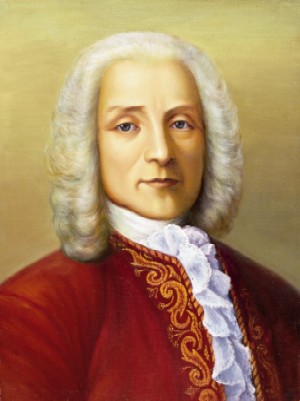
Domenico Scarlatti - Harpsichord Virtuoso


Period: Baroque
Nationality: Italian
Born: October 26, 1685 A.D. in Naples, Italy.
Died:  July 23, 1757 A.D. in Madrid, Spain.
Parents: Alessandro Scarlatti and Antonia Anzalone.
Contemporaries: Johann Sebastian Bach, Arcangelo Corelli, George Friedrich Handel. 
Specialist Genres: Harpsichord Sonatas
Major Works: 550 harpsichord sonatas, Stabat Mater a Dieci Voci e Basso Continuo, cantatas, oratorio, and operas.

            On October 26, 1685, in the city of Naples where classical music was a big deal, the Scarlatti family had their sixth child, it was a son! Mr. Scarlatti named his son Giuseppe Domenico; and just like his father and many other family members, Domenico would one day become an incredible musician. 

                It is a little bit of a mystery how Domenico started learning music. Some people believe that he learned from his father, others say that he learned from his uncles, but there is not much that we can go on. However, we do know that Domenico heard lots of great music, since lots of musicians passed through Naples.

           On September 13, 1701 at the age of 16, Domenico was appointed organist and composer of the Naples royal chapel, the same place that his father was maestro. A year later, Domenico and his father left for Florence where it is possible that they met the man that invented the first piano, Bartolomeo Cristofori. I say possible, because we do not know for sure, since neither Domenico nor Cristofori left us a diary or anything else of the sort.

            Domenico started working for Maria Casimira, the exiled Polish queen, that lived in Rome. Once Domenico started working for Casimira, he was given the opportunity to write at least one cantata, one oratorio and seven operas. Domenico also got to meet other cool composers, like Arcangelo Corelli, George Friedrich Handel, and Thomas Roseingrave. Scarlatti and Handel challenged each other to see who was more talented at the organ and harpsichord. Who do you think won? They both did! Handel was better on the organ and Scarlatti was better on the harpsichord. Scarlatti kept practicing and perfecting himself until he was one of the best  harpsichordists in all of Italy.


             Years pass by and Scarlatii wrote more music, played more music, and traveled around a little bit. It is in 1728 that Domenico Scarlatti did something that he never did before, something very beautiful, fun, and serious at the same time: he got married! 

         Scarlatti was a composer that pushed himself to be as creative as possible, from making the harpsichord to sound like the guitars he heard in Spain to making sure that his music had surprises for whoever approached it. Some people say that his music was witty and even sinister. Do not ever be content with playing your pieces of music one way, always push yourself to play it in the most creative way possible!

            Domenico married Maria Catarina Gentili and they had five children together. Life was good, Domenico is married, has children and he gets to teach King John V's talented daughter  the Infanta Maria Barbara, and King John's younger brother Don Antonio. It was in the years of teaching the Infanta Maria Barbara that Scarlatti wrote some of his most significant and exciting pieces, 500 sonatas for the harpsichord. Scarlatti eventually traveled all the way to Madrid, Spain, where he finished his life and died on July 23, 1757.