After his extensive travels throughout Europe, Berlioz returned to Paris incapacitated by illness and saddened by
many deaths. His first wife died in 1854; his second wife, Maria
Recio, who had been his companion for many years and whom he had married
when he became a widower, died suddenly in 1862. His son,
Louis, on whom Berlioz concentrated the affection
of his declining years, died at the age of 33 of yellow fever.
These dramatic events did not stop Berlioz from composing more music and traveling. In 1861 Berlioz produced his work Beatrice et Benedict, and in 1863 Les Troyens. In 1866 Berlioz journeyed to Vienna and Russia where his music was accepted with great enthusiasm.
Following those
tours, a lonely Berlioz returned to Paris where he died on March 8, 1869.He left behind him many innovative
compositions that had set the tone for the romantic period. He was a great inspiration to composers such as Franz Liszt and Richard Wagner. Although some of his
work was not well received during his life, his popularity increased after his
death. Richard Wanger once said of Berlioz: “The reckless boldness and severe precision…took me by storm and
impetuously fanned the flames of my personal feeling for music and
poetry.”
Career After years of hard work, in 1892 Sergei graduated with a gold medal. He was only 19 years old!
The
gold medal was for his opera Aleko, which was first performed in 1893.
It was admired by a great many people, including Pyotr Tchaikovsky.
(Tchaikovsky even asked if Sergei's opera could be performed with one of
Tchaikovsky's, which excited Sergei very much.) But Sergei's First Symphony was not so well received. In fact, nobody liked it. Sergei was
so upset that he stopped composing for a while. He didn't write any more music for
almost three years.
He
did start writing again, though, and before World War I started, he had
written three concertos, two more symphonies, a symphonic poem, many
songs, and lots of piano music. The piano music was written partly for
his own amazing hands, so the music is very difficult and full of wide
stretches. In
1902, Sergei finally married his fiancée and cousin Natalia Satina. In
the beginning, Sergei was in love with her younger sister, Vera,
but Vera and Natalia's mother would have none of that. So Sergei wrote
back and forth with Natalia. By the time of their wedding, they had been
engaged for three years.
In
1917, the Russian Revolution broke out. The Rachmaninoff family were
aristocrats, and so the forty-four-year-old Sergei moved to Switzerland
with his family (his wife and two daughters) and decided to focus more
on the piano. Many people in the United States offered him work as a
composer, and although he turned them down, he finally decided that
moving to America would solve some of his financial problems. In 1935,
he moved to the United States. He kept composing during this time, even
though he was very sad to leave Russia. He and his family tried to make
their house in America like their house in Russia.
Sergei
became ill during a concert tour in late 1942 and was diagnosed with
melanoma, a type of skin cancer (The doctors told his family, but not
him). Soon after, he and his wife became American citizens, just two
months before he died. He died in Beverly Hills, California, four days
before his 70th birthday. Music Sergei
wrote a lot of music, including: Piano Concerto No. 4; the Variations on a Theme by Corelli, for solo piano; the Rhapsody on a Theme of Paganini, for piano and orchestra; the Third Symphony; and the Symphonic Dances, as well as pieces like Vocalise, Variations on a Theme of
Chopin, and The Isle of the Dead. Sergei Rachmaninoff has been somewhat
forgotten, but his music is still popular. He was perhaps the best
pianist of his lifetime. As part of his daily warm-up exercises, Sergei
would play the difficult Étude in A flat, Op. 1, No. 2, by Paul de
Schlozer. When performing, he would go up on stage, sit down at the
piano, and wait for the audience to be quiet. When he played, it was
perfect: he never made a mistake, and his playing could be heard in the
back row of the music hall. And he remembered things - if he heard a
piece of music just once, he could remember it for a long time, note by
note. He could sit down the next day, or six months later, or ten years
later, and play it on the piano. He was dedicated to music - he once
said, "That is the most important thing for me in my interpretations,
color. So you make music live. Without color it is dead."
Contemporaries:Johannes Brahms, Camille
Saint-Saens, Antonin Dvorak, Claude Debusey, Gustav Mahler, Edvard, Grieg,
Frederic Chopin, Franz Liszt, Gabriel Faure, Robert Schumann, Richard Wagner,
Nikolai Rimsky-Korsakov, Modest Mussrogsky, Cesar Cui, Alexander Borodin, Mily
Balakirev
Specialist
Genres: ballet
music and symphonies
Major
Works:The Nutcracker, Swan Lake,
Sleeping Beauty, Violin Concerto, Piano Concertos, 6 symphonies, 1812
Overture.
Have
you ever heard of The Nutcracker? Or Sleeping Beauty? Or
even Swan Lake? Most people have, but they may not know much about
the man behind the music. The man is Pyotr Ilyich Tchaikovsky and he was born
in Votkinsk, a small town in Russia’s Ural Mountains. Tchaikovsky lived during stirring
times: the United States of America was in the Great Depression, Samuel Morse
invented “Morse Code”, David Livingstone went as a missionary to Africa, lower
and upper China united, Crawford Long uses first anesthetic (ether), Edgar Allen Poe came out with The Raven and Other Poems, and Charles H. Spurgeon
impacted England and America with his great sermons from the Bible.
It was
in these tremendous times that Pyotr Ilyich Tchaikovsky played the piano and
wrote lots of cool classical music with a Russian twist. Alongside ballet
music, Tchaikovsky wrote symphonies, the
1812 Overture, a violin concerto and piano concertos. Tchaikovsky had what
many composers living in his time did not: “a sweet, inexhaustible,
supersensuous fund of melody.”[1]
His
Life & Music
Pyotr
Ilyich Tchaikovsky was born on May 7, 1840. From a young age Tchaikovsky had an interest
in music, but his parents wanted him to study law, just like G.F. Handel.
Tchaikovsky was an obedient son and went to law school, but he also kept pursuing
music. Eventually, Tchaikovsky went to
the St. Petersburg Conservatory to study music composition and the piano, which
led him to be considered one of the most popular classical music composers of
all time.
After
the St. Petersburg Conservatory, Tchaikovsky was given the great gift of
marriage, but he did not treasure marriage. Tchaikovsky divorced his wife a few
weeks after they were married, choosing to run away from her and focused on his
music. Music was more important to Tchaikovsky, too bad he did not choose to
love both music and his wife. He did write a lot of beautiful music, symphonies
and piano concertos and a violin concerto and ballet music and tone poems and
more. In 1891, Tchaikovsky even came to America to conduct his music for
people. And in 1884, Emperor Alexander III and even got a pension (money for
retirement). People really like his ballet music, his symphonies and even the
concertos for its beauty, deep emotion, lyricism in the Russian style.As two historians put it, “The music which
this unhappy man created was gorgeously colored, sometimes delicate and
fairy-like, sometimes almost hysterical in its tragic passion.”[2]
[1]Harold
C. Schonberg, The Lives of the Great
Composers, revised edition (New York: Norton Company, 1981), p. 377.
[2]Katherine
B. Shippen and Anca Seidlova, The Heritage of Music (New York: Viking
Press, 1963), p. 204.
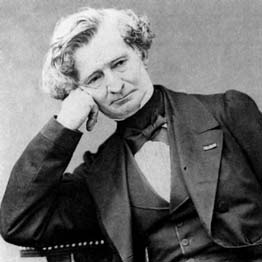 After his extensive travels throughout Europe, Berlioz returned to Paris incapacitated by illness and saddened by
many deaths. His first wife died in 1854; his second wife, Maria
Recio, who had been his companion for many years and whom he had married
when he became a widower, died suddenly in 1862. His son,
Louis, on whom Berlioz concentrated the affection
of his declining years, died at the age of 33 of yellow fever.


