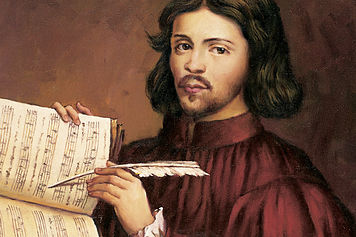
Work and Music
Thomas Tallis is often called "the Father of English church music" because
he was the first well-known composer to write substantially for the Anglican church.
The earliest works we have by Tallis are songs to the Virgin Mary, a
very important figure in Roman Catholicism. When England became more of a
Protestant country, Tallis' style changed - he wrote most of his music
set to the liturgy, which is basically a
church service written down. Through this phase in his life, Tallis was among the first church
musicians to write anthems set to English words, even though Latin
continued to be used as the primary language. Then, when the Catholic monarch Queen Mary rose to
the throne, so Tallis switched his style back to the Roman Catholic way. After
that, Queen Elizabeth I came to power, starting a more Protestant puritanical
mood and so Tallis went back to writing in the Protestant style.
Through the years Tallis did a lot of work with William Byrd, one of his students. Queen Elizabeth granted
them a patent to print and publish music and exclusive rights to print
any music in any language, if it was for the church. But since they were
both strong Roman Catholics in a Protestant
country, thier music didn't sell very well. However, Tallis kept the respect
of others through the religious upheaval.
Tallis didn't like the more modern style of his young students like
William Byrd. Tallis was content to write music just for the liturgy of the church. He
composed during a difficult time of struggle between Catholicism and
Protestantism, and his music often shows that
struggle.
Thomas Tallis died in 1585 in
Greenwich, England and was buried in the parish of St. Alfege Church.Though little is know about him, Thomas Tallis is still considered by many as one of the greatest composers of English sacred music! Spem in Alium and If Ye Love Me are two of his most famous pieces that are well known and still sung today. This is a little poem about Thomas Tallis that has been found:
“Entered here doth ly a worthy wyght,
Who for long tyme in musick bore the bell:
His name to shew, was THOMAS TALLYS hyght,
In honest virtuous lyff he dyd excell.
“He serv’d long tyme in chappel with grete prayse
Fower sovereygnes reygnes (a thing not often seen);
I meane Kyng Henry and Prynce Edward’s dayes,
Quene Mary, and Elizabeth oure Quene.
“He mary’d was, though children he had none,
And lyv’d in love full thre and thirty yeres
Wyth loyal spowse, whose name yclypt was JONE,
Who here entomb’d him company now beares.
“As he dyd lyve, so also did he dy,
In myld and quyet sort (O happy man!)
To God ful oft for mercy did he cry,
Wherefore he lyves, let deth do what he can.”
*Written by Rachel, Suzuki book 3 student
Showing posts with label Thomas Tallis. Show all posts
Saturday, February 14, 2015
Saturday, February 7, 2015
Spem in Alium - Thomas Tallis' 40-Voice Motet
Thomas Tallis is renowned for his wonderful choral pieces. Spem in Alium is a polyphonic motet written for 40 voices in an 85-part choir. We are not sure why Tallis decided to write this huge piece for 40 voices or even why he chose specifically 40 voices, but it is a beautifully splendid piece. Let's keep in mind that this was pop of his time and most of the music was written for church services, as most people in Europe at the time were professing Christians.
The words are from a church service and they talk about God's gracious character to deal with man's sins, since man cannot fix the wrongs that he has done. So this entire motet is a personal prayer asking God for forgiveness. In the Catholic church, their services were in Latin, since it was the predominant language for a while when all of Europe was a part of the Roman empire. Here they are translated in English :
I have never put my hope in any other but in You,
O God of Israel
who can show both anger
and graciousness,
and who absolves all the sins of suffering man
Lord God,
Creator of Heaven and Earth
be mindful of our lowliness
Labels:
motets,
polyphonic music,
privatelessonmatters,
renaissance music,
spem in alium,
Thomas Tallis
Location:
France
Tuesday, February 3, 2015
Thomas Tallis: Fading into History
Historical Period: Renaissance
Nationality: English
Born: c. 1505
Died: November 23, 1585
Contemporaries: William Byrd, Giovanni Pierluigi de Palastrina, Orlande de Lassus, Andrea Gabrielli, Robert White
Work: Puer Natus Est Nobis, Lutheren chants, Mass for Four Voices
What's Happening in History:
Henry VIII is the king in England, Martin Luther posts his Ninety-Five Theses on the door of Castle Church in Germany, Copernicus publishes his theory that the earth orbits the sun.
Life
Much of Thomas Tallis' early life is hidden from us, but he was one of the greatest composers of his time. Thomas Tallis was born circa (around) 1505 toward the end of the reign of Henry VII. It is thought that Tallis was part of the Chapel Royal St. James' Palace, because he joined it later as a man. The first place music took him was in 1532 when he became an organist of a Benedictine priory called Dover Priory in Kent, England. Tallis then went to London to an Augustinian monastery in Essex, England.
When the monastery broke up in 1540, Tallis went to Canterbury Cathedral, and then to the English royal Court, where he composed and performed for the monarchs Henry VIII, Edward VI, Queen Mary, and Queen Elizabeth I. As the monarchs changed, the country was torn between Catholic and Protestant monarchs seeking to force their religion on the rest of the nation while persecuting those on the other side. Tallis avoided the mess, even though both he and his friend/student William Byrd were ardent Roman Catholics. In these tumultuous years Tallis was able to switch his music style to fit the different monarchs' demands, showing his creativity and brilliance. Tallis was not only a composer, but as many musicians of his time, he was a music teacher as well. Two of his most renowned students include William Byrd, who was a composer, and Elway Bevin, who was an organist.
Amidst all his work, Tallis married Joan around 1552, who outlived him by four years. Unfortunately, Thomas and Joan were never able to have any children, so they did not experience the joys of parenthood. But this sadness did free Tallis up to focus on his music.
Subscribe to:
Posts (Atom)