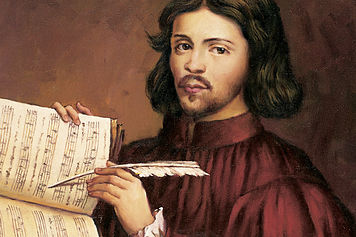
Thomas Tallis is often called "the Father of English church music" because he was the first well-known composer to write substantially for the Anglican church.
The earliest works we have by Tallis are songs to the Virgin Mary, a very important figure in Roman Catholicism. When England became more of a Protestant country, Tallis' style changed - he wrote most of his music set to the liturgy, which is basically a church service written down. Through this phase in his life, Tallis was among the first church musicians to write anthems set to English words, even though Latin continued to be used as the primary language. Then, when the Catholic monarch Queen Mary rose to the throne, so Tallis switched his style back to the Roman Catholic way. After that, Queen Elizabeth I came to power, starting a more Protestant puritanical mood and so Tallis went back to writing in the Protestant style.
Through the years Tallis did a lot of work with William Byrd, one of his students. Queen Elizabeth granted them a patent to print and publish music and exclusive rights to print any music in any language, if it was for the church. But since they were both strong Roman Catholics in a Protestant country, thier music didn't sell very well. However, Tallis kept the respect of others through the religious upheaval.
Tallis didn't like the more modern style of his young students like William Byrd. Tallis was content to write music just for the liturgy of the church. He composed during a difficult time of struggle between Catholicism and Protestantism, and his music often shows that struggle.
Thomas Tallis died in 1585 in Greenwich, England and was buried in the parish of St. Alfege Church.Though little is know about him, Thomas Tallis is still considered by many as one of the greatest composers of English sacred music! Spem in Alium and If Ye Love Me are two of his most famous pieces that are well known and still sung today. This is a little poem about Thomas Tallis that has been found:
“Entered here doth ly a worthy wyght,
Who for long tyme in musick bore the bell:
His name to shew, was THOMAS TALLYS hyght,
In honest virtuous lyff he dyd excell.
“He serv’d long tyme in chappel with grete prayse
Fower sovereygnes reygnes (a thing not often seen);
I meane Kyng Henry and Prynce Edward’s dayes,
Quene Mary, and Elizabeth oure Quene.
“He mary’d was, though children he had none,
And lyv’d in love full thre and thirty yeres
Wyth loyal spowse, whose name yclypt was JONE,
Who here entomb’d him company now beares.
“As he dyd lyve, so also did he dy,
In myld and quyet sort (O happy man!)
To God ful oft for mercy did he cry,
Wherefore he lyves, let deth do what he can.”
*Written by Rachel, Suzuki book 3 student